Help · Reports and taxes
Tax prep in Tallybook
What Tallybook's tax center does for sole proprietors and single-member LLCs: Schedule C, quarterly estimates, 1099s and an accountant package, and what it doesn't do.
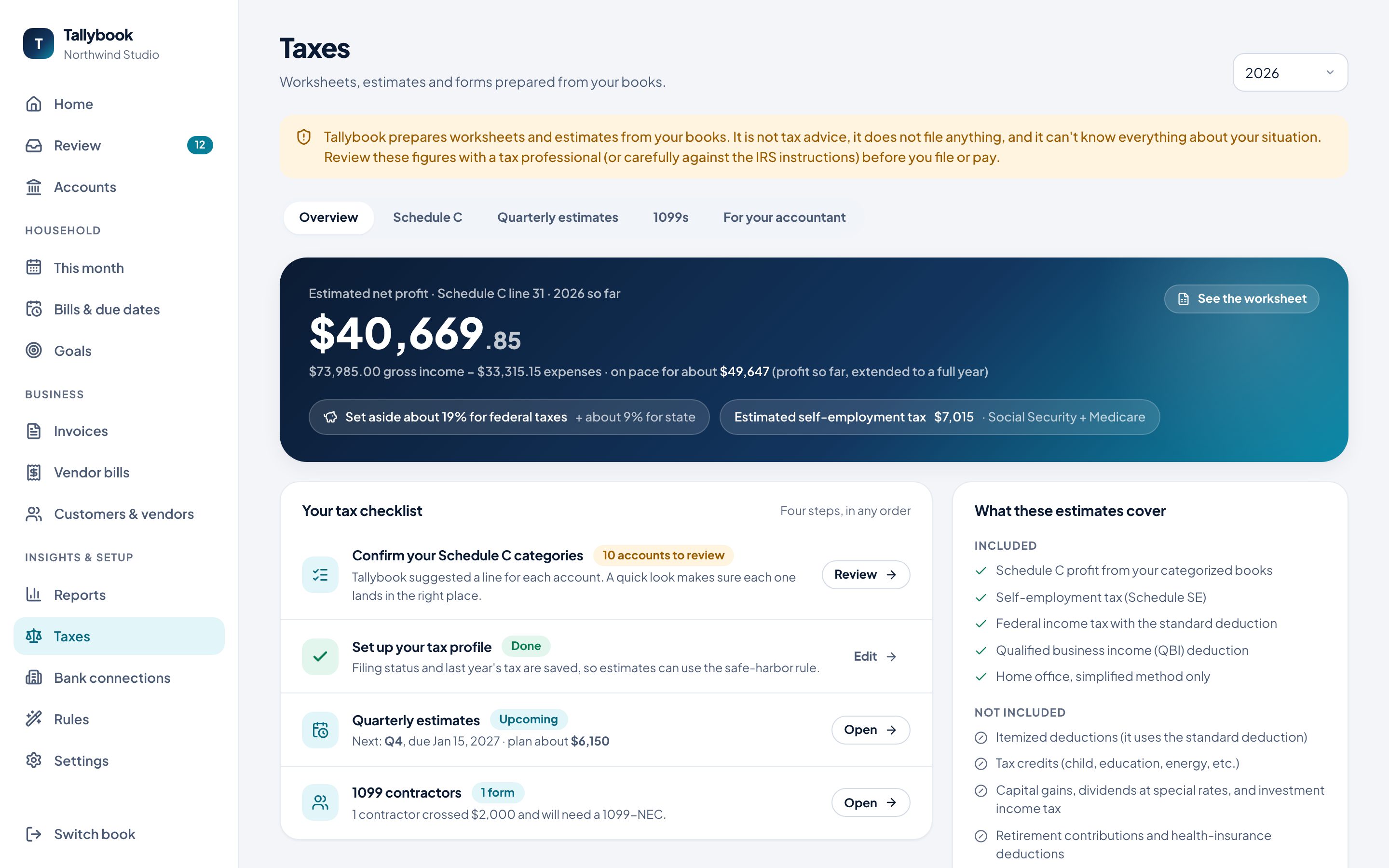
Tallybook’s Tax Center turns your books into the worksheets and numbers you need at tax time. It’s built for sole proprietors and single-member LLCs that file Schedule C with their Form 1040.
What it is: a preparer’s assistant. It organizes, calculates and explains, and every figure shows where it came from.
What it isn’t: tax advice or a filing service. Tallybook never submits anything to the IRS or a state. Review its figures with a tax professional, or carefully against the IRS instructions, before you file or pay.
What it does
| Area | What you get |
|---|---|
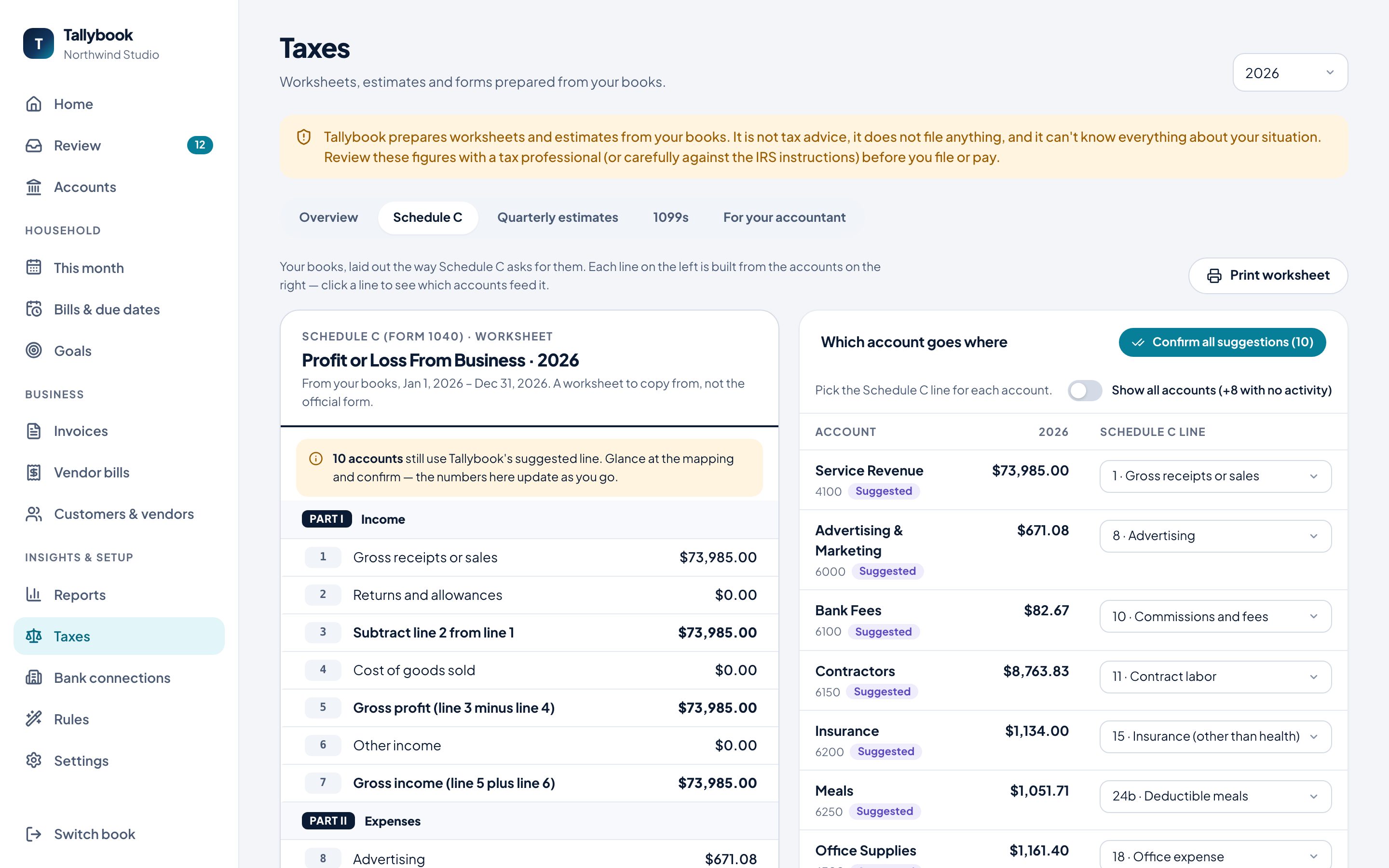
| Schedule C | Each income/expense account is mapped to a Schedule C line. Tallybook suggests the line and you confirm it. You get a line-by-line worksheet with meals limited to 50% and an optional simplified home-office deduction. |
| Quarterly estimates | A plan for federal estimated tax (Form 1040-ES) with due dates and payment tracking. Payments are recorded as owner’s draws, because estimated income tax is personal, not a business expense. |
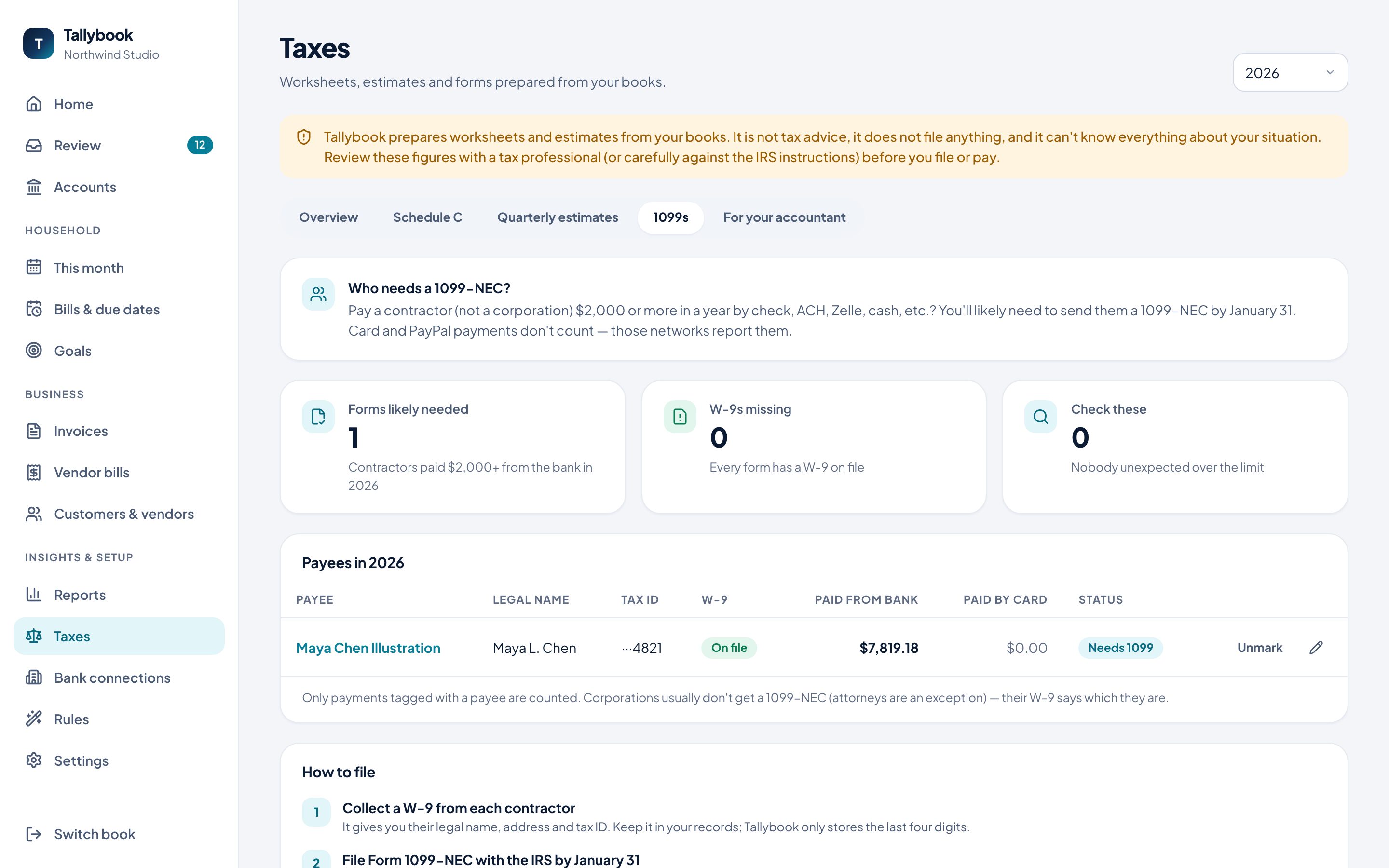
| 1099s | Totals paid to each payee, split into bank payments (reportable by you on 1099-NEC) and card payments (reported by the card networks, not you). Flags who’s over the threshold and whose W-9 is missing. |
| Accountant package | A folder with a readable tax summary and general ledger as PDFs, plus the Schedule C worksheet, account mapping, general ledger, 1099 summary and estimated payments as spreadsheets, and a README. |
Two ways to plan estimates
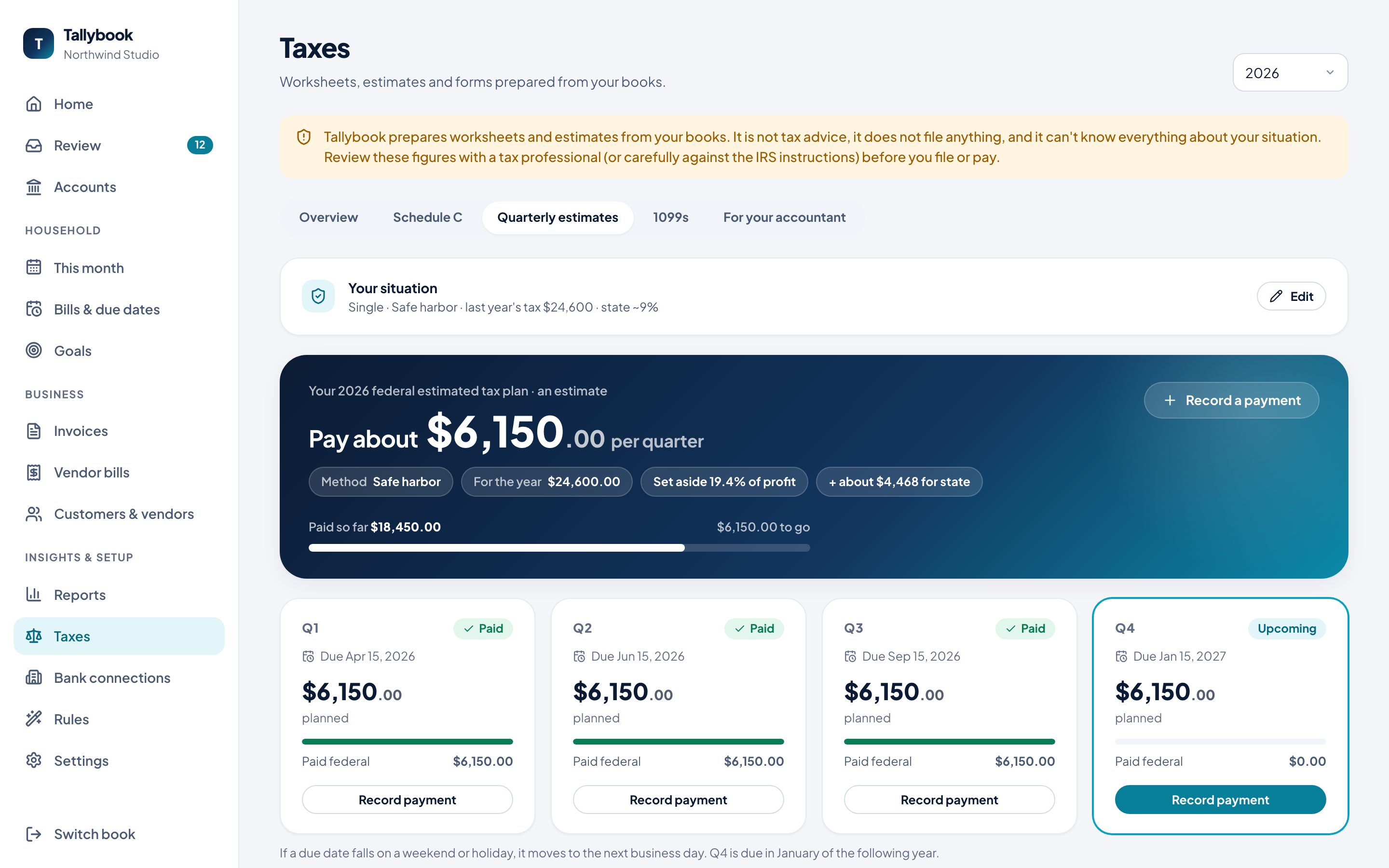
- Safe harbor (recommended). Pay last year’s total tax in four equal parts, or 110% of it if last year’s AGI was over $150,000 ($75,000 married filing separately). That avoids the federal underpayment penalty no matter how much you earn this year. It needs only two numbers from last year’s return.
- This year’s projection. Tallybook projects the year from your books. It computes self-employment tax (Schedule SE), additional Medicare tax, the standard deduction, a simplified QBI deduction, and federal income tax from the brackets. Paying 90% of the current year’s tax also avoids the penalty, but this number moves as your income changes.
Record each payment under Taxes → Quarterly estimates → Record a payment, so the plan knows what’s left.
Not included in the projection
- Itemized deductions (it uses the standard deduction)
- Tax credits (child, education, energy…)
- Capital gains and qualified dividends at special rates; net investment income tax
- Retirement contributions and self-employed health insurance deductions
- Newer special deductions (tips, overtime, car-loan interest, seniors)
- QBI above the threshold, where the real deduction depends on facts Tallybook doesn’t have. It’s left out, which is conservative.
- State and local income tax (a rough state set-aside rate is optional)
1099s and the accountant package
Taxes → 1099s lists everyone you paid this year, with their W-9 status and whether they need a 1099-NEC. Export the 1099 summary gives you or your preparer the totals.
Taxes → For your accountant → Create tax package writes the whole folder. Running it again replaces the files with fresh ones.
Privacy
Only the last four digits of a contractor’s tax ID are stored. The full number belongs on the W-9 and on the IRS filing, not in the book file or in exports.
Tax tables
Each tax year’s figures come from the IRS and SSA publications listed below. A year without published tables is refused, never guessed.
| Year | Brackets, standard deduction, QBI | Wage base | 1099-NEC threshold |
|---|---|---|---|
| 2025 | IRS Rev. Proc. 2024-40; standard deduction as amended by Pub. L. 119-21 | SSA: $176,100 | $600 |
| 2026 | IRS Rev. Proc. 2025-32 | SSA: $184,500 | $2,000 (Pub. L. 119-21) |
The tax engine is checked against the cumulative-tax figures printed in the IRS Revenue Procedures before every release.